Why new hires still feel unprepared after Onboarding

Most companies have already improved the operational side of onboarding.
Workday manages employee records, approvals, and HR workflows. OnRamp orchestrates onboarding processes across teams and systems. Jira keeps onboarding tasks organized and moving. Together, they replace spreadsheets, scattered Slack messages, and forgotten follow-ups with a structured process.
But there is a problem many teams eventually run into.
A new hire can complete every onboarding task, receive every account, attend every scheduled meeting, and still not actually be ready to do the job.
That is because onboarding logistics and onboarding learning are two completely different things. You can process an employee without properly preparing them.
Where operational onboarding ends
Most modern organizations already rely on a stack of tools to manage onboarding at scale.
Workday handles employee records, approvals, and HR workflows.
OnRamp coordinates onboarding journeys across teams and systems.
Jira tracks tasks, tickets, and operational execution.
Together, they remove the chaos of manual onboarding, replacing spreadsheets, Slack threads, and ad-hoc coordination with structured, automated workflows.
But even when all of this works perfectly, a gap still remains.
A new hire can complete every onboarding task, receive every account, attend every scheduled meeting, and still not actually be ready to do the job.
That is because operational onboarding and learning onboarding solve two fundamentally different problems.
Operational Onboarding vs Learning Onboarding
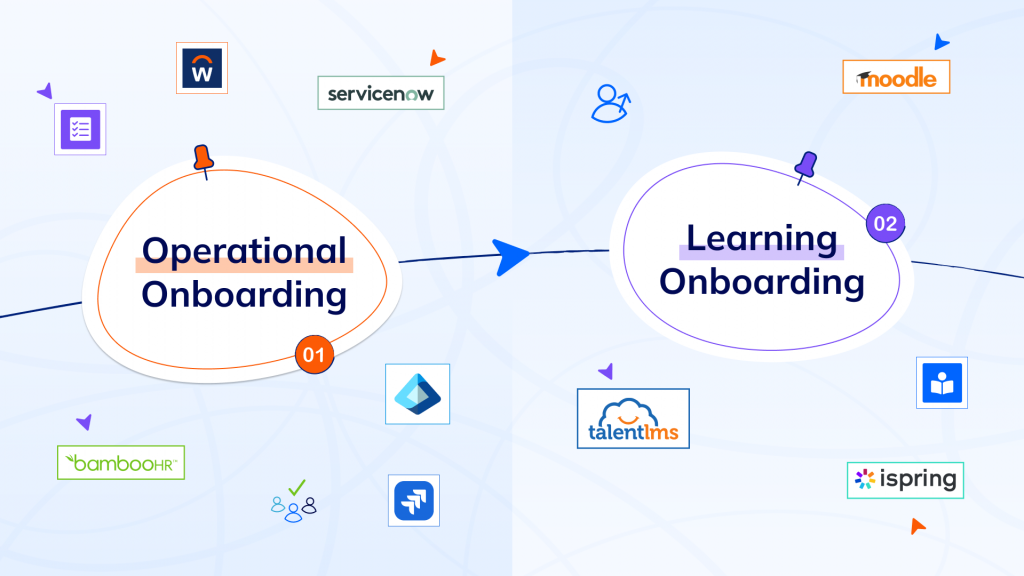
Operational Onboarding:
These systems measure whether onboarding tasks happened.
A completed Jira ticket confirms that access was granted.
A completed HR workflow confirms that approvals were processed.
But neither confirms whether the employee is actually ready to perform their role effectively.
Operational onboarding is about execution:
- Accounts created
- Access granted
- Equipment delivered
- Workflows completed
It ensures the employee can enter the system.
But it does not ensure they can perform inside it.
Learning onboarding fills the gap left by operational systems.
Most organizations already have onboarding knowledge documented inside Confluence. The problem is structure.
New hires are often handed dozens of pages without knowing:
- Where to begin
- What matters most
- How information connects
So instead of learning a role, they end up having to navigate documentation.
Operational onboarding creates access.
Learning onboarding creates understanding.
Operational onboarding answers: “Are they set up?”
Learning onboarding answers: “Are they ready?”
Smart Courses for Confluence: turning documentation into learning
Smart Courses for Confluence transforms Confluence from a documentation platform into a structured learning environment built around the knowledge your team already maintains there, not a separate LMS you have to migrate content into.
That distinction matters.
In most organizations, onboarding knowledge evolves constantly alongside the business. Smart Courses keeps the learning experience connected to the same Confluence environment employees will use long after onboarding ends.
Instead of navigating isolated wiki pages on their own, new hires progress through a well-organized catalog with course cards and structured learning paths with clear progression and measurable outcomes.
Assign courses: New hires are automatically enrolled based on their group, so learning starts on day one without anyone needing to set it up manually. Once they join the group, they will receive a notification to take the course.
Exams and quizzes: comprehension gets verified at each stage, which matters most for compliance, security, and product knowledge, where misunderstanding has real consequences
Certifications: employees earn a record of what they have completed, and managers can see who is genuinely ready, not just who has finished the tasks
Learning paths: onboarding is organized into a guided progression so new hires move through knowledge in the right order, from foundational concepts to role-specific expertise, instead of navigating pages on their own
Skills and prerequisites: courses can require specific knowledge or completed modules before unlocking the next stage, ensuring no one skips steps they are not ready for.
How Workday, OnRamp, Jira, and Smart Courses work together
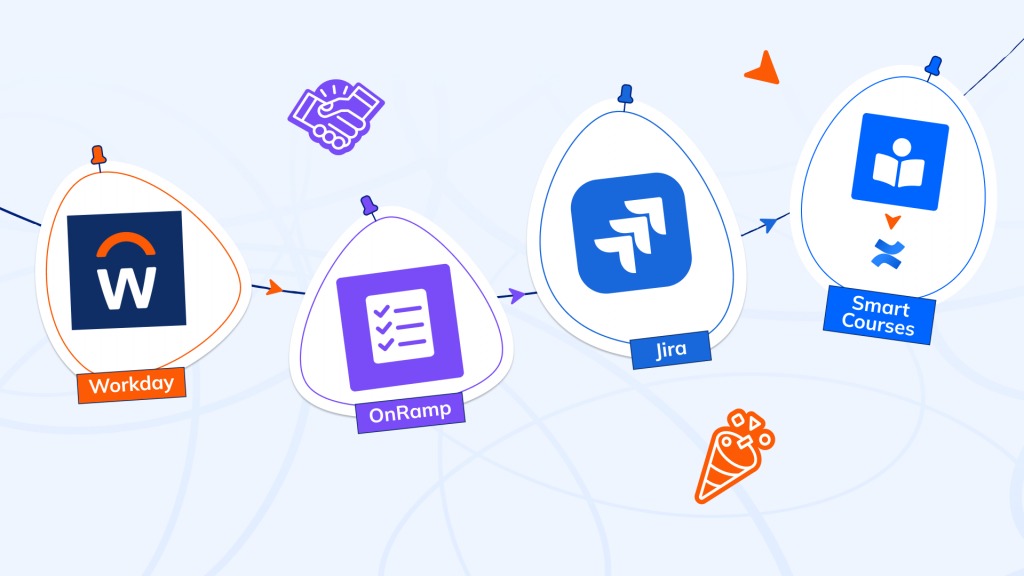
These tools complement each other so effectively because each solves a different onboarding problem.
Workday manages the employee record and HR workflows
OnRamp orchestrates onboarding journeys and cross-team coordination
Jira manages operational execution and task tracking
Smart Courses manages the learning layer that transforms documentation into structured onboarding and measurable capability development
A new employee can be created in Workday, automatically enrolled in onboarding workflows through OnRamp, assigned operational tasks in Jira, and guided through structured learning paths in Confluence via Smart Courses.
Operational onboarding and learning onboarding become connected rather than isolated from each other.
The Use Case: Onboarding a senior backend engineer
Move the engineer from “signed contract” to “shipping their first line of code” in 10 days, while ensuring they understand security protocols and system architecture along the way.
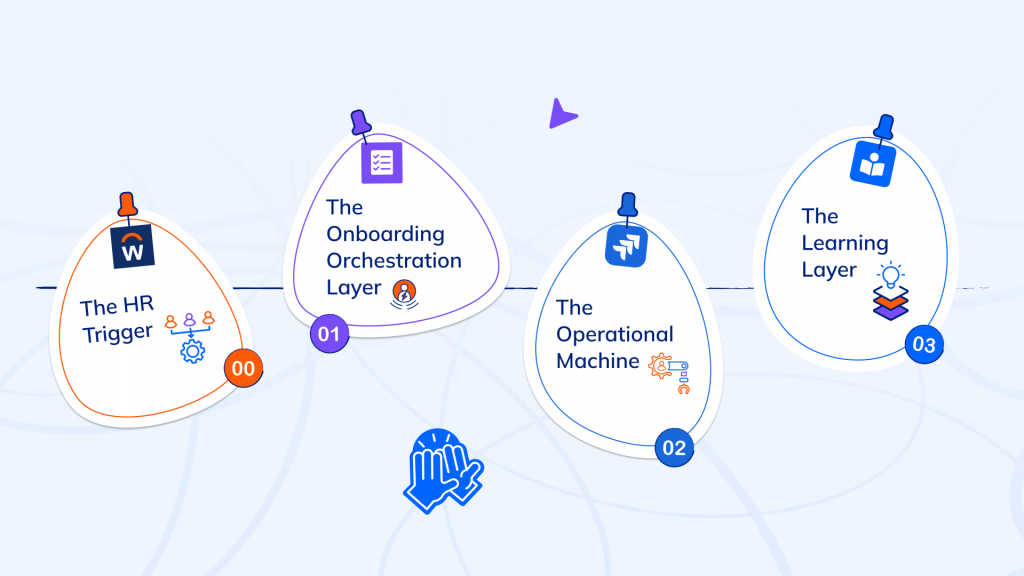
Phase 0: Workday the HR trigger
Everything starts in Workday.
Once HR marks the candidate as “Hired,” the employee record is created and synchronized across systems. Role, department, and onboarding metadata are now available to the rest of the stack.
This is what officially triggers the onboarding process.
Phase 1: OnRamp the orchestration layer
From that moment, OnRamp takes over coordination.
It connects HR, IT, and engineering teams into a single onboarding flow:
IT is notified to prepare provisioning
HR receives compliance tasks
Managers get onboarding checklists
The new hire receives timelines and communication
Jira onboarding projects are automatically prepared
At this point, onboarding is no longer manual it is orchestrated across systems.
Phase 2: Jira, the operational execution layer
Next comes execution.
A Jira onboarding project is automatically created and populated with tasks across teams.
IT provisions a MacBook Pro, GitHub access, and AWS permissions.
Managers are reminded to schedule onboarding sessions and introductions.
Security teams handle access reviews and compliance approvals.
Everything that needs to be physically and operationally set up is now tracked and completed.
But even when everything is marked as done, a gap remains.
Jira confirms the engineer is equipped not that they are ready.
They may have the laptop, the access, and the tickets completed… but still not understand deployment safety standards or backend architecture principles.
Phase 3: Smart Courses for Confluence, the learning layer
This is where onboarding shifts from execution to understanding.
Instead of navigating a long list of Confluence pages, the engineer enters a structured learning path built directly from the company’s existing documentation.
They are guided step by step through the knowledge they actually need to perform the role.
At the end of the “Security Standards” module, they complete a short quiz to validate understanding.
Once completed, Smart Courses generates a certification:
“Learning Path Complete: Security Certified.”
ConfluenceLearningOnboarding