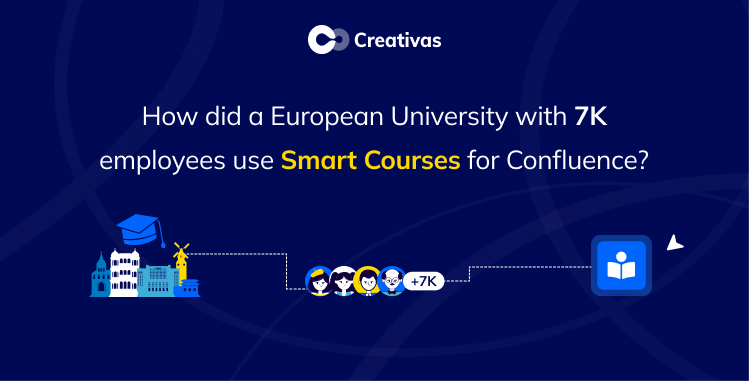
How did a European University with 7K employees use Smart Courses for Confluence for onboarding and training?

At a European university with approximately 7,500 employees, onboarding and training used to depend entirely on live sessions. The team could record who attended, but it had no e-learning option and limited visibility into employees’ competence levels.
The university introduced Smart Courses for Confluence to give employees another way to complete training. Two years later, the customer reported more than 200 courses and over 5,000 users, with adoption that exceeded the team’s expectations.
Additionally, the change also brought a surprising benefit: onboarding and training made HR more visible in employees’ everyday experience.
This story is based on feedback shared by a university client. Name and details have been withheld at its request.
The challenge: live sessions were the only option
The university manages both mandatory training, such as IT security, and voluntary learning. This includes communication training.
Before Smart Courses, live sessions determined all aspects. The customer described the lack of e-learning as inconvenient, leaving employees with no online alternative.
There was also a difference between recording attendance and understanding readiness. The team knew who had attended a session, but it said little about competence levels.
For an institution supporting thousands of employees, the opportunity was clear: make training available in another format and connect learning more closely with the work employees needed to do.
Adding e-learning without removing live training
Furthermore, with Smart Courses for Confluence, the university added an online option to its onboarding and training offer.
For mandatory training, employees can choose e-learning or attend a live session. The university continues to offer both formats, giving employees a choice in how they complete the training.
This approach let the team introduce digital learning within its existing training process. Live sessions remained available, and employees gained another way to access required learning.
For HR teams facing a similar challenge, the lesson is practical: expanding a training program can start with giving employees an additional route through it.
Connecting training to workplace software access
The university uses courses to support decisions about granting access rights to workplace software. The sentence is split into two to improve clarity and readability.
Training has a direct purpose in this process. Employees must understand the systems they will use, and courses help the university prepare them for that responsibility.
This connects employee learning with an operational need. A course becomes part of helping someone use a workplace tool appropriately.
The customer’s feedback illustrates a useful application for internal training. It connects learning requirements with the tools employees need for their roles.
Fitting e-learning into a broader reporting process
Smart Courses supports e-learning delivery in Confluence. However, the university uses another system to manage its wider training records and reporting.
This lets the team bring information about its training activities together in one reporting environment.
Introducing e-learning does not necessarily mean replacing every part of an established training management process. In this case, Smart Courses became part of the university’s wider approach to delivering and reporting on employee learning.
Allowing more people to create courses
When asked what had improved most after adopting Smart Courses, the customer highlighted two things: having e-learning available and allowing people across the university to create courses.
That second change broadened who could contribute to onboarding and training.
Colleagues with knowledge to share could create learning content, helping the university build its course offerings through contributions from across the institution.
For an HR team serving a large workforce, this is a meaningful shift. Internal expertise has a route into employee learning, and course creation can involve the people closest to the subject.
Two years later, the university reported more than 200 courses.
The results: over 5,000 users in two years
The customer reported results after two years of using Smart Courses. They include the following:
| Area | Customer-reported outcome |
|---|---|
| Course offering | More than 200 courses |
| Adoption | Over 5,000 users across a workforce of approximately 7,500 |
| Awareness | E-learning reached more people than the team had expected |
| IT support | A noticeable decline in IT-related support questions |
The team was particularly encouraged by the number of employees involved. Awareness of the e-learning offer had grown beyond its expectations.
The customer also observed a decline in IT-related support questions.
An unexpected benefit: making HR more visible
Before Smart Courses, many employees had little awareness of HR’s work. Consequently, after its introduction, employees were using the platform almost every day. This gave them a more direct experience of what HR provided.
Training created a recurring point of contact. Employees had a reason to engage with an HR service as part of their working lives. For the team, that made its contribution more visible through something employees could use regularly.
This is one of the university’s notable parts. As a result, expanding access to learning strengthened employees’ connection with HR.
What other HR teams can take from this experience?
The university’s experience offers three practical lessons. These lessons also relate to employee training in Confluence.
Start with the gap employees experience. Additionally, the immediate problem was the absence of e-learning. Adding an online option gave employees more choice while preserving live sessions.
Connect learning with everyday responsibilities. Courses supported software access decisions, giving onboarding and training a clear purpose tied to employees’ work.
We involve internal knowledge holders. Opening course creation across the university allowed more colleagues to contribute to the learning offer.
For this university, Smart Courses became an established part of employee training within two years. More than 200 courses and over 5,000 users show its reach. Additionally, the customer’s feedback highlights a broader benefit: making learning and HR more present in employees’ working lives.
Looking to expand employee training in Confluence?
Explore how Smart Courses can support your team’s learning needs.
ConfluenceLearningOnboarding